124 Friction Points: Rebuilding the HubSpot GTM Engine
TL;DR
- The Challenge: GTM teams were working in silos. While everyone was trying to help the customer, they were doing it in their own ways without unity, leading to messy handoffs and a lack of visibility into the customer journey.
- The Fix: I mapped the entire Sales Cycle journey to find 124 friction points, then migrated 6 teams into a rebuilt HubSpot UX with standardized data governance and unified onboarding milestones.
- The Win: Reduced customer onboarding time by 35% and improved sales cycle time by 50% through workflow optimization and automations.
🔍 The Deep Dive
1. Identifying the Gap
When I joined the bizops team, "time-to-value is slow" and "handoffs are terrible" were the common complaints. After interviewing stakeholders across Sales, SEs, and CSMs, I realized the problem wasn't a lack of effort, it was a lack of alignment.
I socialized the findings in an Onboarding Kickoff where we identified that teams were pulling in different directions. We were operating reactively rather than proactively. The result was a Sales Cycle Journey Map that visualized the messy middle and pinpointed 124 distinct friction points, including:
- Handoff Black Holes: A chronic lack of notes affecting the transition from Sales to Implementation.
- Fragmented Visibility: Customers had no idea what they still needed to do to ramp up, and internally, no one was sure who was responsible for updating which fields in HubSpot.
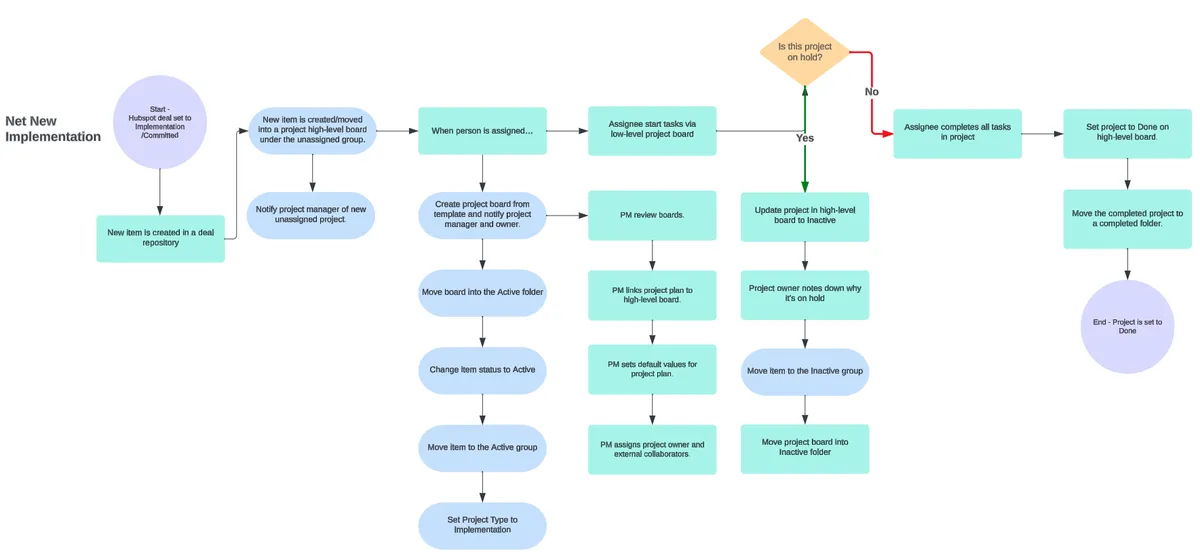
The Journey Map: Visualizing the "messy middle" to identify key bottlenecks.
2. Consolidating 6 Teams
We weren't just cleaning up HubSpot; we were migrating six different teams into a unified revenue funnel to establish a single source of truth.
- Reducing the Data Debt: Auditing hundreds of legacy properties and merging duplicates that were confusing the team.
- Object Modeling: Re-architecting how Deals, Companies, and custom objects related to each other to improve the user experience and reporting accuracy.
3. Designing for Adoption
I believe that if a process fails, it's a design failure. I rebuilt the HubSpot UX to be user-friendly and personalized:
- Organized Deal Pages: Re-structured the UI so that the most critical onboarding milestones were front and center.
- Playbooks: Built ‘knowledge-in-flow’ tools to guide Sales Reps through discovery calls, ensuring consistent data collection and a smoother handoff to technical teams.
- Conditional Logic: Only showing the fields that actually matter for the current deal stage to reduce the mental load on reps.
- Automations: Using workflows to automate customer follow-ups, internal task reminders, and anything else that was helpful.
4. The Result
By moving from reactive to proactive system design, we saw immediate improvements in organizational health:
- 35% Faster Onboarding: Reducing time-to-value for new customers.
- 50% Better Sales Cycle Time: Reps spent less time hunting for info or fixing data and more time moving deals forward.
💡 Reflection
Inefficiencies come from each team trying to help the customer in their own way. By starting with the human journey rather than just the tool features, I built a system that encouraged everyone to work toward the same goal.